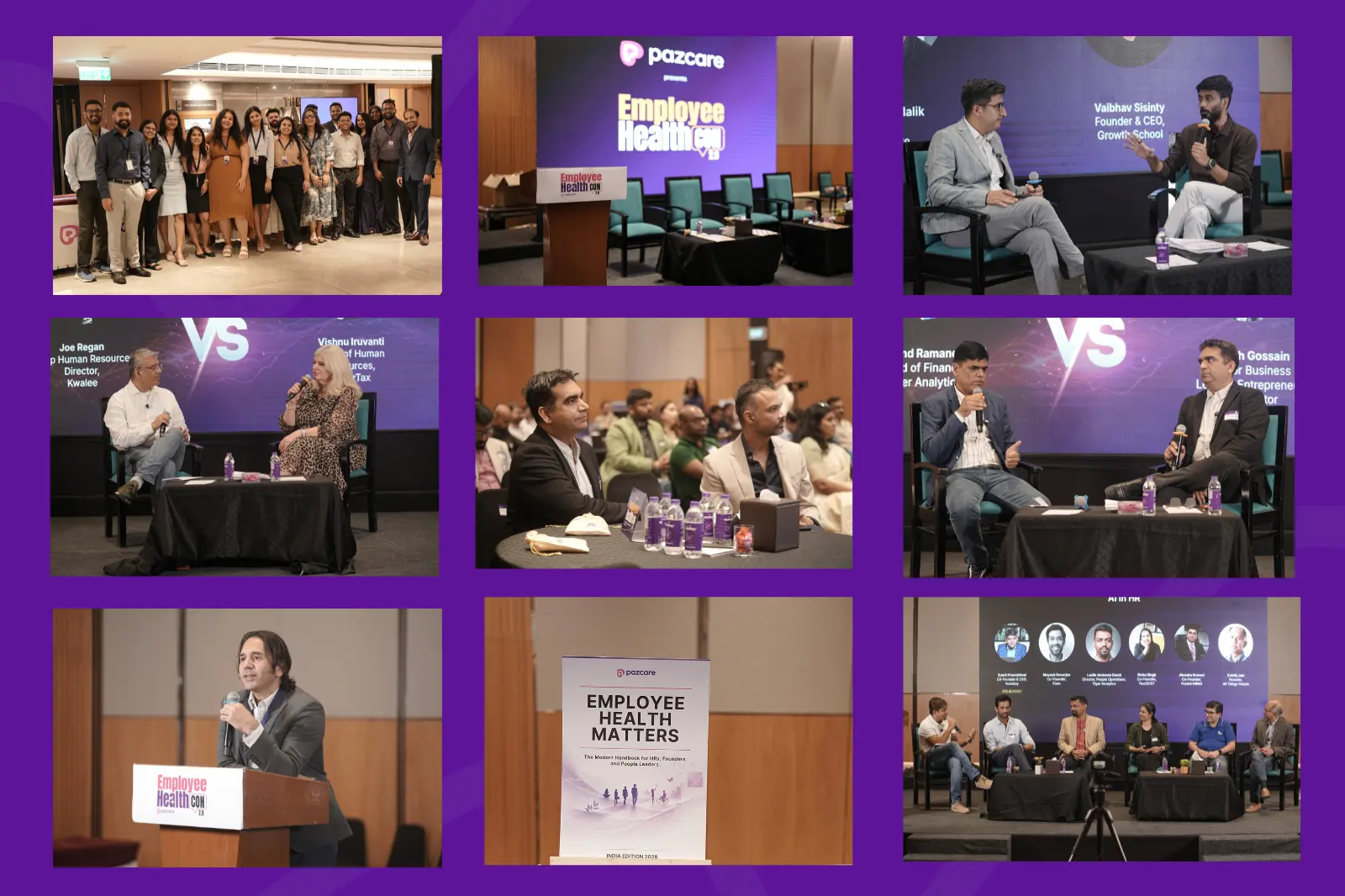
On 25 February 2026, Pazcare brought together some of India's sharpest HR leaders, founders, and people managers, from across startup and enterprise for one shared purpose: To have honest conversations about the health of the people who keep businesses running. Not the usual corporate wellness checkbox talk but real, sometimes uncomfortable, often surprising discussions about burnout, AI, and what kind of work culture we actually want to build.
On 25 February 2026, Pazcare brought together some of India's sharpest HR leaders, founders, and people managers, from across startup and enterprise for one shared purpose: To have honest conversations about the health of the people who keep businesses running. Not the usual corporate wellness checkbox talk but real, sometimes uncomfortable, often surprising discussions about burnout, AI, and what kind of work culture we actually want to build.
A big thank you to the partners who made the event possible:
Platinum Sponsor: HealthIndia
Gold Sponsor: Medi Assist
Wellness & Reward Partner: Xoxoday
HRMS Partner: Pocket HRMS
Community Partners: TSOW Community, SpringVerify, Goodfit, Springworks, EngageWith, Unwind Ventures
To add a fun touch to the start of the day, attendees received thoughtfully curated goodie bags, which quickly became people’s favourite. The bags included contributions from brands like Keya, Kalaa Kriti, Gen Life, Dezy, Confelty, Orange Health Labs, Liya.AI, Total Gift Solutions, Koach Box, and Yoga Bar, along with a Pazcare laptop sticker.
The day kicked off with an opening address by Manish Mishra, Co-founder of Pazcare, setting the tone for everything that followed: employee health is not a benefit. It is a business strategy.
One of the first highlights of the day was the launch of the Employee Health Matters Handbook — India Edition 2026. Unveiled by Sanchit Malik (CEO, Pazcare),Shivani Burman Sharma (Senior Vice President, MediAssist), and Chetan Y (Head of HR, Cashfree Payments), the handbook is built on the analysis of 77,000 insurance claims and 15,000 health checkups across India's working population.
The handbook brings together 14 chapters covering key aspects of employee wellbeing, based on real health and claims data. It looks at 14 major health areas, combining insurance claims insights with early warning signs from preventive health checkups. The goal is to give HR leaders a 360-degree view of employee wellness, covering both physical health and mental health trends in India’s workforce.
Moderated by Vikas Lachhwani (Founder, mCaffeine), this panel brought together three founders who have lived through the grind of building companies while trying not to fall apart in the process: Dhruv Gupta (Co-Founder, Orange Health), Zishaan Hayath (Founder & CEO, Toppr), and Amal Mishra (Co-Founder & CEO, Urban Vault).
When it came to physical health, the founders all agreed on one thing: sleep is the foundation. Dhruv Gupta shared that he treats 7 to 8 hours of good sleep as non-negotiable. Along with that, he makes sure to spend an hour every day doing some form of intense physical activity. He also gets blood tests done every 3 months, treating his health the same way he would monitor any important system. Zishaan Hayath shared that he only started going to the gym at 41 and wishes he had started much earlier. His message to the audience was simple: Make movement a habit rather than something that depends on discipline, because habits are easier to maintain than relying on willpower.
The conversation then shifted to mental health, which the founders spoke about openly. Dhruv Gupta acknowledged that difficult phases are unavoidable while building a company. Instead of fighting those moments, he believes it helps to accept them, be kinder to yourself, and take a break even if that just means watching a movie for a while.
Amal Mishra highlighted the importance of having “safe people” in your life, someone like a co-founder or close friend who can listen without judgment when things get overwhelming. He also shared an important point about leadership and team culture: if a bad day makes you snap at someone, apologize. It shows your team that leaders are human too.
Zishaan Hayath offered a simple trick for days when work stress carries into personal life: change your environment. Something as small as taking a shower or moving to a different space can help reset your mind and break that cycle. The panel also discussed a concept called Non-Exercise Activity Thermogenesis (NEAT), the idea that small movements during the day can add up to significant health benefits. Things like walking during calls, taking the stairs, or simply moving around more at work can make a big difference over time.
When the conversation turned to building a healthy team culture, the founders agreed that it starts with leadership. If leaders want their teams to prioritize wellbeing, they need to lead by example whether that means encouraging people to go to the gym, normalizing therapy, or even bringing home-cooked meals to the office. In the end, the message was clear: Culture is not defined by what leaders say, but by what they consistently do every day.
Panel 2: AI in HR and Employee Benefits
Moderated by Sumit Khandelwal (Co-Founder & CEO, Xoxoday), this panel was one of the most practically rich conversations of the day. Speakers included Mayank Banerjee (Co-Founder, Even), Leslie Andrews David (Director, People Operations, Tiger Analytics), Richa Singh (Co-Founder, YourDOST),Jitendra Somani (Co-Founder, Pocket HRMS), and Kshitij Jain (Founder, All Things People).
The most repeated phrase of the session: AI is a force multiplier, not a replacement. Leslie Andrews David described how chatbots trained on HR policy documents can answer employee queries instantly, no waiting for HR to respond to questions about maternity leave at 11pm. AI can write more contextual performance feedback, remind employees proactively about PF nominations before they lapse, and handhold new joiners from offer acceptance through their first year.
Jitendra Somani made the case that AI fundamentally shifts what HR spends its time on. Historically, the function was 70% transactional and 30% strategic. AI has the potential to flip that ratio, predictive salary forecasting, team-level attrition risk scoring, attendance pattern alerts, things that once required weeks of manual analysis can now run continuously in the background. He pointed the room toward Nexus by Yuval Noah Harari as worth reading for a broader understanding of what this shift means for organizations.
Kshitij Jain talked about linking organizational data to real business outcomes using a three-lens model: Culture, Capability, and Commitment. His team builds team-level attrition risk scores and manager capability toolkits moving HR from reactive firefighting to proactive intervention before people start looking for the exit.
Richa Singh brought the session's most important caution: data privacy is not negotiable, especially in mental health. India has one of the highest burnout rates in the world, with 80% of Gen Z employees showing symptoms. YourDOST has walked away from deals where clients wanted individual-level mental health data. That boundary, she said, is exactly what makes the product trustworthy in the first place.
Mayank Banerjee highlighted a standout real-world example: one organization that implemented a focused parenthood program saw post-maternity return-to-work rates jump from 27% to 96%. The combination of AI-driven proactive employee benefits management and genuine human care is what drives outcomes like that.
What's New at Pazcare
The afternoon included a product launch from Pazcare, showcasing its next generation of tools. Three new features stood out.
PazGPT is an AI chatbot that operates 24/7, across every channel, in multiple languages designed to autonomously resolve over 70% of routine employee queries while routing complex cases to human agents. PazClaims AI uses document verification to catch the 22+ most common errors that lead to claim rejection or delays, meaning fewer back-and-forths and faster settlements for employees exactly when they need them. The PazSuper Wallet is a flexible benefits wallet covering wellness, learning, and productivity spend, with AI-driven real-time reimbursement, no blocked working capital, no waiting.
Between the panels, comedian Rahul Robin took the stage for a stand-up special. It was the right call. A room full of people who spend their days solving serious problems needed a moment to exhale. The laughter was loud and it was earned and it made the quiet point that joy is one of the most underrated workplace health interventions we have.
Debate 1 : Hustle Culture — Problem Vs Pride?
This session turned into one of the most engaging debates of the day. Joe Regan argued that hustle culture is often a problem disguised as something admirable. On the other hand, Vishnu Iruvanti defended hustle as something that can drive progress and create pride in meaningful work.
Joe’s argument focused on the real cost of overwork. She pointed out that the UK loses around £100 billion every year due to sick leave, and unhealthy work cultures contribute to this. When companies glorify working nonstop, it often leads to burnout, which eventually affects productivity and business results. Her suggestion was simple: Companies should measure results instead of hours worked, train managers to identify early signs of burnout, and create workplaces where setting boundaries is respected rather than judged.
Vishnu responded with a different perspective. He referred to the Japanese idea of Ikigai, which is about living with purpose and energy. According to him, hustle can be positive when it is connected to something meaningful. He gave examples like Michael Jordan, who became great because of intense effort.
During the discussion, someone from the audience raised an important point. Many employees at startups choose to hustle because they believe strongly in the mission, not because they are forced to. Joe agreed with this idea. Hustle can make sense in the early stages of building something new. The issue arises when companies expect that same level of intensity forever, even after the organization has grown.
In the end, both speakers reached a similar conclusion. Hustle itself is not the real problem. The challenge is understanding when to push hard and when to slow down and recover. The real cultural issue is not hustle, but treating hustle as something that should never end.
Fireside chat: Winning the AI-first World
In conversation with Sanchit Malik (CEO, Pazcare), Vaibhav Sisinty (Founder & CEO, Growth School) delivered the most immediately actionable session of the entire day.
Vaibhav shared how he has built a content engine that generates around 100 million views every month, powered largely by AI. Much of his content workflow runs on an automated system. AI clones manage his audio and video presence, research agents identify trending topics, and scripts are generated in his style and tone. A scoring system then predicts how likely each piece of content is to go viral and decides what should be published. The only part still handled manually is video editing.
According to Vaibhav, the pace of AI development is moving much faster than most people expected. The speed is driven by intense competition between major players like OpenAI, Google, as well as Chinese AI labs and emerging Indian companies such as Sarvam AI. This competition is pushing the world closer to Artificial General Intelligence, where AI systems could perform tasks across many domains like humans.
He described the current moment using a simple framework: Orchestrators vs Resistors.
Orchestrators are people who actively use AI to amplify their work and productivity.
Resistors are those who tried early AI tools, found them imperfect, and stopped using them while the technology continues to improve rapidly.
For HR professionals, Vaibhav suggested three practical AI workflows that could be implemented almost immediately.
1. Resume search agent Create an AI system that indexes all past candidate resumes into a searchable database. Instead of relying on keyword filters in an ATS, recruiters can simply ask questions in natural language to find the right candidates.
2. HR policy Q&A bot Connect company HR policies to a conversational AI that employees can access through tools like Slack. Employees can then ask questions and get instant answers without needing to contact HR each time.
3. Onboarding and employee lifecycle assistant Use AI to guide employees through key stages such as onboarding, policy updates, or benefits queries. This reduces the need for HR teams to manually respond to the same questions repeatedly.
Vaibhav ended with a simple exercise for the audience. Write down everything you do in a typical week. Then circle the tasks you wish you didn’t have to do. According to him, almost 80% of those tasks can already be automated with AI today.
Debate 2 : Work From Home vs Office
The final debate set Devanand Ramandasani (Head of Finance, Tiger Analytics) arguing for WFH against Hitesh Gossain (Senior Business Leader, Entrepreneur & Educator) arguing for the office.
Devanand approached the topic from a finance perspective. According to him, flexibility helps companies reduce employee attrition, and replacing employees is expensive. When people work from home, they also save time that would otherwise be spent commuting. That extra time can go into work, health, or personal routines like going to the gym, joining early international calls, or even starting the day with yoga.
He also pointed out that remote work has improved participation of women in the workforce, as it makes it easier to balance professional and personal responsibilities. In his view, flexibility is not just a benefit for employees, it is also a strategic advantage for companies trying to retain talent.
Hitesh argued that the office plays a deeper role than just being a workspace. He explained that the modern office system dates back to around 1815, when American railroad companies needed physical offices to manage complex operations and coordination. From the beginning, offices were not just about desks, they were about bringing people together so information and ideas could flow naturally.
His framework: Resourcefulness equals Access multiplied by Awareness. Remote work makes it easy to schedule meetings and access people on calendars. However, it often lacks awareness, the informal interactions that happen in hallways, quick conversations near a desk, or noticing that a colleague might be struggling just by seeing them in person. Hitesh also raised an important social point. For many people who enter the workforce after 2020, the office may be their only regular space for social interaction. With loneliness becoming a growing global issue, completely remote work can sometimes make people feel more isolated.
Despite their different viewpoints, both speakers acknowledged that most companies have settled somewhere in the middle: a hybrid work model. Ultimately, they agreed on one core idea. Regardless of whether employees work from home or from the office, leaders must focus on creating a supportive and human-centered work environment.
As both speakers concluded in their own way: when you take care of your people, your people will take care of the business.
Wrapping up Employee HealthCon 2.0
The healthiest companies aren’t the ones that simply offer wellness perks. They’re the ones that build health into the way they work every day. Doing that requires honest conversations, real data, and leaders who are willing to address difficult issues instead of avoiding them.
Employee HealthCon 2.0 made a strong case that those conversations are finally, seriously, underway. See you next year.
Aditya Malik is the Chief Revenue Officer at Pazcare, driving growth and strategy for the employee benefits platform. With 20+ years in consulting and technology, he is passionate about workplace wellbeing. He frequently writes about employee benefits, insurance, and the future of work, making complex topics easy to understand.
Follow on:
Thanks for subscribing! If it’s your first time, check your inbox. Otherwise, you’re already on our list
Oops! Something went wrong while submitting the form.
Ready to give yourself and your team the best employee benefit experience?







.svg)
.svg)