Group health insurance is one of the most valuable employee benefits organizations offer today. It protects employees and their families from unexpected medical expenses, improves financial security, and strengthens an employer's overall benefits strategy.
Yet when it comes to managing a group health insurance policy, many HR teams focus almost entirely on renewals. They compare premium quotes, negotiate with insurers, review benefit changes, and finalize the policy for another year.
Every hospitalization, reimbursement request, cashless approval, and claim rejection leaves behind valuable data. Hidden within this data are insights about employee health trends, healthcare utilization, policy effectiveness, and future insurance costs. Unfortunately, most organizations only receive a claims report once or twice a year. The report may contain figures such as total claims incurred, premium paid, and incurred claims ratio (ICR). While these metrics are important, they rarely provide the full picture. They tell HR leaders what happened but not why it happened.
As healthcare costs continue to rise with 14% medical cost inflation and insurers become more selective about pricing, understanding claims data has become a strategic necessity. Organizations that can extract meaningful insights from their claims experience are often better equipped to control costs, improve employee satisfaction, and negotiate stronger renewals.
What is claims data in group health insurance?
Most employers understand premiums and renewals, but fewer understand the value hidden inside their claims data. Claims data is the record of every healthcare expense submitted under a group health insurance policy. It contains information such as:
- Number of claims filed
- Claim amount
- Settled amount
- Rejected amount
- Employee and dependent utilization
- Hospital details
- Disease categories
- Cashless vs reimbursement claims
- Claim turnaround time (TAT)
When analyzed correctly, this data helps employers understand the effectiveness of their group health insurance policy and identify opportunities to improve employee healthcare outcomes while controlling costs.
Before your next renewal discussion, here are five questions every HR leader should be asking about their group health insurance claims data.
1. Are we overpaying for group health insurance?
One of the biggest concerns HR teams face during renewal season is the proposed premium increase. It is common for insurers to cite medical inflation, rising hospitalization costs, and increased utilization as reasons for revising premiums upward.
While these factors certainly influence pricing, employers should avoid assuming that every premium hike is justified.
The first place to start is by evaluating the group health insurance policy's Incurred Claims Ratio (ICR). This metric compares the claims paid by the insurer against the premium collected from the organization. A healthy ICR generally indicates that the policy is performing as expected and that employees are utilizing their benefits appropriately.
However, looking at the ICR alone is rarely enough. For instance, a company may have an ICR of 90%, which appears healthy on paper. But what if most of those claims came from just a few high-cost hospitalizations? What if the claims trend has been declining over the last six months? What if the insurer is proposing a 20% premium increase despite relatively stable utilization?
These are questions that traditional claims reports often fail to answer. A deeper analysis of claims data can reveal whether the proposed increase aligns with actual policy performance. It can also help employers benchmark their claims experience against similar organizations and understand whether they are paying a fair group health insurance premium.
When HR teams enter renewal discussions armed with this information, conversations become far more strategic. Instead of simply accepting the insurer's recommendation, they can negotiate from a position of strength backed by data.
2. Who is driving our group health insurance premium costs?
Most organizations know how much they spend on group health insurance claims each year. Group health insurance costs are rarely distributed evenly across a workforce. In many cases, a relatively small percentage of claims account for a large share of overall expenses. Identifying these cost drivers is essential for making informed decisions about employee benefits.
Sometimes the highest costs are linked to specific relationships covered under the policy. Spouses, children, or parents may contribute significantly to overall utilization depending on the workforce demographic.
Insights from Pazcare's Employee Health Matters Report highlight why this analysis is becoming increasingly important. The report found that maternity-related claims continue to be one of the largest contributors to employer healthcare spending. It also revealed a growing burden of lifestyle-related conditions such as diabetes, hypertension, thyroid disorders, and cardiac ailments among working professionals.
In other cases, the biggest contributors may be certain hospitals, geographic locations, or medical conditions. For example, a company may discover that maternity-related claims account for a significant portion of annual healthcare spending. Another organization may find that chronic conditions such as diabetes, hypertension, or cardiac illnesses are becoming increasingly common among employees.
Understanding who is driving healthcare costs enables organizations to make smarter decisions. HR teams can introduce targeted employee wellness programs, expand preventive healthcare initiatives, improve employee education, and ensure that the group insurance policy for employees aligns with actual workforce needs.
3. Why are claims getting rejected?
Few things frustrate employees more than a rejected health insurance claim.
From an employee's perspective, a claim rejection often feels like a broken promise. They enrolled in the policy, sought treatment when needed, and expected financial support during a medical event. When the claim is denied, HR is usually the first team they approach for answers.
The challenge is that many organizations only see the number of rejected claims. They rarely understand the underlying reasons behind those rejections. In reality, not every rejection occurs because a treatment is excluded under the policy. Many claims are rejected due to documentation gaps, delayed submissions, incomplete paperwork, or procedural errors during the claim process.
An employee may fail to submit supporting medical documents. A reimbursement claim may be filed beyond the permitted timeline. A cashless authorization request may not follow the required process. These seemingly small issues can lead to claim denials and employee dissatisfaction.
By examining rejection patterns, HR teams can identify recurring problems and address them proactively. If documentation-related rejections are increasing, employees may need better guidance on claim filing requirements. If cashless claims are frequently denied at specific hospitals, additional employee education may be required. If certain policy exclusions are causing confusion, communication around coverage can be improved. Reducing claim rejections not only improves the employee experience but also increases trust in the organization's group health insurance policy.
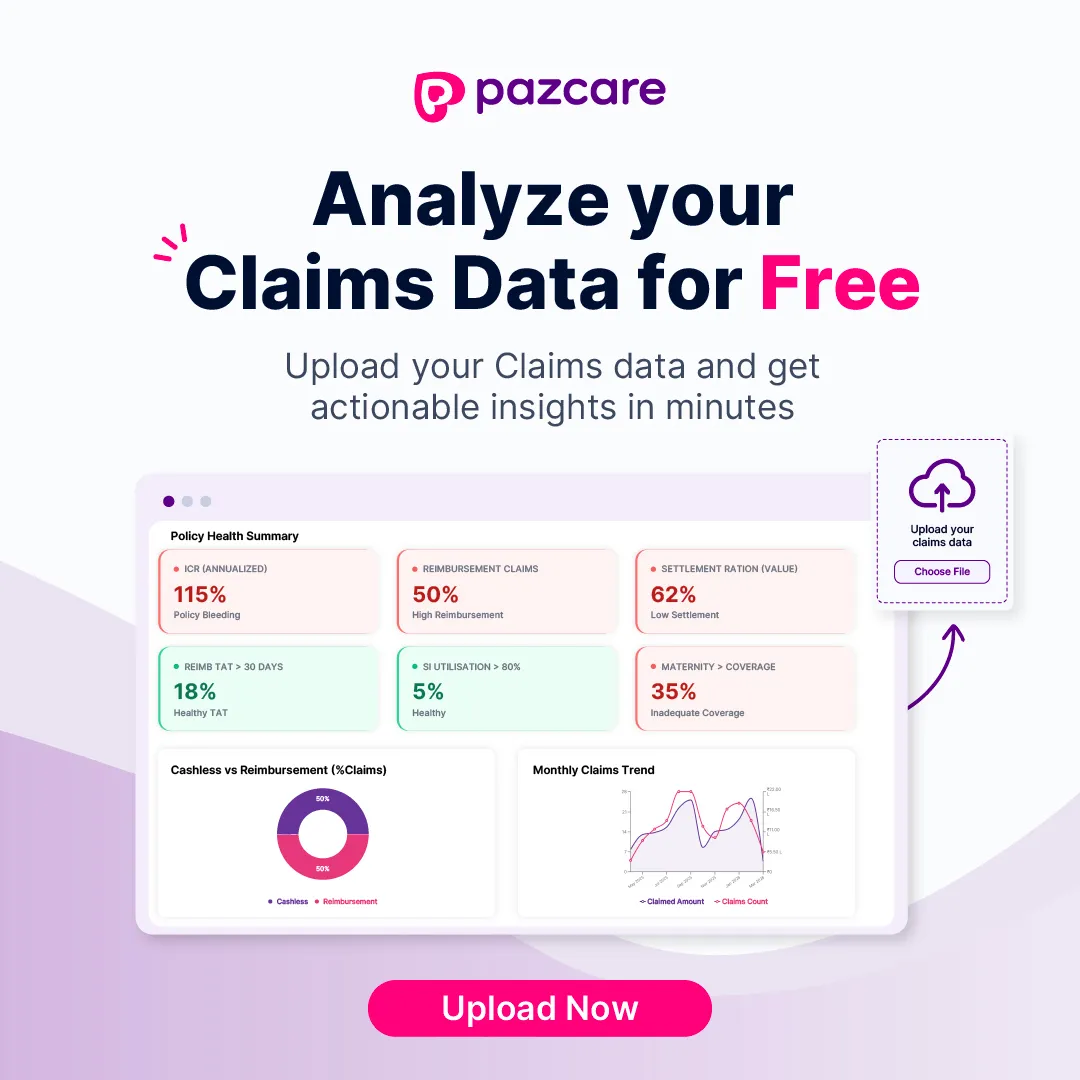
With Paz Claims IQ, you can upload your claims data and instantly uncover what's driving costs, why claims are getting rejected, and where your policy may need improvement.
4. What hidden risks could increase next year's group health insurance premium?
Many HRs only begin examining claims data once renewal discussions are already underway. By that point, insurers have often completed their assessment and determined the premium adjustments they intend to propose.
The reality is that claims data can reveal warning signs months before renewal season begins. For example, a growing number of high-value claims may indicate rising claim severity. Employees consistently exhausting their sum insured limits may signal that coverage levels need to be reviewed. An increase in hospitalizations related to chronic illnesses could point toward long-term healthcare risks within the workforce.
Similarly, trends in maternity utilization, mental health claims, or lifestyle-related diseases may have implications for future healthcare spending. When these patterns are identified early, organizations have time to act.
HR teams can strengthen preventive healthcare initiatives, introduce disease management programs, encourage health screenings, and review policy design before insurers incorporate the risk into renewal pricing. In many ways, claims data functions as an early warning system. Organizations that monitor these signals proactively are often better positioned to manage future healthcare costs and avoid unpleasant surprises during renewal negotiations.
5. Are we prepared for the renewal conversation?
For many organizations, the annual renewal discussion revolves around a single question: how much will the premium increase?
But the most successful HR teams approach renewals differently. Rather than focusing solely on price, they evaluate the overall effectiveness of their group health insurance policy and use data to guide decisions. Before entering renewal discussions, employers should understand which policy features employees value most, which benefits are underutilized, and which coverage limitations create friction during the claims process.
Claims data often highlights important areas for improvement. A high number of claim deductions may indicate restrictive room-rent limits. Frequent employee complaints could point to gaps in maternity coverage or mental health benefits. Benchmarking against market standards may reveal that competitors are offering stronger benefits despite paying similar premiums.
Renewal discussions should also involve a detailed review of claim trends, rejection patterns, utilization levels, and emerging health risks. When HR leaders bring this information to the table, conversations shift from reacting to insurer recommendations to actively shaping the future of the policy.
The result is a more balanced negotiation process that prioritizes both cost management and employee wellbeing.
How can HR teams turn claims data into actionable insights?
Most organizations already possess the data needed to make better insurance decisions. The challenge is not collecting the information. The challenge is interpreting it.
Traditional claims reports provide numbers, charts, and summaries. What they often lack is context. They rarely explain what the numbers mean, what trends deserve attention, or what actions HR teams should take next.
This is where claims intelligence becomes valuable.
Modern AI-powered analytics tools can process thousands of group health insurance claims within minutes and identify patterns that would be difficult to detect manually. They can highlight cost drivers, uncover claim rejection trends, benchmark policy benefits against market standards, forecast renewal outcomes, and generate actionable recommendations.
Instead of spending days analyzing spreadsheets, HR teams can focus on making informed decisions.
As employee healthcare costs continue to rise, organizations that embrace claims intelligence will gain a significant advantage. They will be better equipped to control costs, improve employee experiences, optimize benefits, and negotiate renewals with confidence.
Ready to understand what's really driving your health insurance costs?
Upload your claims data and receive an AI-generated claims intelligence report that uncovers cost drivers, identifies policy gaps, highlights claim rejection trends, benchmarks your policy against market standards, and helps you walk into your next renewal discussion with confidence.









.svg)
.svg)