For most HR leaders and finance teams, the annual renewal of a group health insurance policy comes with one major concern: Rising premiums. A policy that cost ₹10 lakhs last year could suddenly cost ₹12–15 lakhs during renewal. In some cases, companies may even receive renewal quotes that are 20–30% higher than their previous premium.
This often raises questions such as:
- Why does the premium increase every year?
- Is the insurer increasing prices randomly?
- Can employers do anything to reduce these hikes?
- How can companies continue offering quality health benefits without increasing costs dramatically?
The reality is that group health insurance premium increases are not random. Insurers evaluate multiple factors before determining renewal pricing. Some factors are within an employer's control, while others are influenced by broader healthcare and market trends.
Why do group health insurance premiums increase every year?
Several factors influence the average group health insurance premium that employers pay. While every organization is different, insurers generally assess a combination of claims history, employee demographics, healthcare inflation, and coverage structure before deciding renewal pricing.
Let's look at the biggest reasons behind annual premium hikes.
1. High claims ratio
The claims ratio is often the single most important factor influencing a renewal premium. A claims ratio compares the total amount paid out by the insurer against the premium collected from the company.
For example:
- Annual premium paid by employer: ₹20 lakhs
- Total claims paid by insurer: ₹28 lakhs
In this scenario, the insurer has paid significantly more than it collected. From an underwriting perspective, the policy has become loss-making.
As a result, the insurer may:
- Increase premiums during renewal
- Modify policy terms
- Introduce higher deductibles
- Reduce flexibility in future negotiations
A single large claim can affect pricing, but insurers usually pay greater attention to overall utilization patterns across the employee population. This is why companies with consistently high claims often experience steeper renewal increases than companies with healthier claims performance.
2. Medical inflation continues to rise
Medical inflation remains one of the biggest drivers of increasing group health insurance premiums in India.
Healthcare costs have grown steadily over the past decade due to:
- Rising hospitalization costs
- Increasing doctor consultation charges
- Expensive diagnostic procedures
- Advanced medical technologies
- Growing demand for specialized treatments
A hospitalization that cost ₹1 lakh five years ago may cost significantly more today.
Even if your organization's claims remain stable, insurers factor rising treatment costs into future pricing calculations.For employers, this means that some level of premium increase may occur even when claim utilization has not changed significantly.
If you're wondering whether your renewal quote is reasonable, use Pazcare's group health insurance premium calculator to estimate premiums based on your workforce size, coverage requirements, and benefits structure.
3. Aging workforce
Employee demographics play a major role in determining risk.
As employees grow older, the likelihood of medical treatment, hospitalization, and chronic health conditions increases.
Insurers generally evaluate:
- Average employee age
- Average dependent age
- Number of parents covered
- Existing medical conditions
- Historical utilization trends
For example, a company with an average employee age of 27 may attract lower premiums compared to a company where the average age is 40.
Similarly, organizations that offer parental coverage often experience higher claims utilization because older individuals are naturally more likely to require medical care. This does not mean employers should avoid offering comprehensive benefits.
4. Expansion of benefits and coverage
As organizations compete for talent, many choose to enhance their employee benefits programs.
These improvements may include:
- Higher sum insured
- Maternity coverage
- Newborn baby coverage
- OPD benefits
- Mental health support
- Wellness benefits
- Coverage for parents and in-laws
While these additions improve employee experience and retention, they also increase the insurer's financial exposure.
For example, increasing coverage from ₹5 lakhs to ₹10 lakhs raises the insurer's potential liability significantly. Similarly, maternity and parental coverage tend to increase claims frequency because they are actively utilized benefits.
Every enhancement has a cost implication, which is reflected in the group health insurance premium.Employers should therefore evaluate which benefits deliver the greatest employee value before making coverage changes.
5. Increase in employee headcount
Business growth is usually positive, but it can affect insurance costs. As organizations hire more employees, insurers reassess the overall risk profile of the group.
An increase in workforce size often leads to:
- More insured members
- Greater claims exposure
- More dependent enrollments
- Increased healthcare utilization
While larger groups can sometimes benefit from better pricing due to economies of scale, rapid expansion can also lead to premium recalculations.
The insurer may need to adjust assumptions about future claims, particularly if new employees belong to different age groups or geographic locations. This is why fast-growing startups often notice changes in renewal pricing even when claims remain relatively stable.
6. Industry risk profile
Not all industries carry the same level of health risk.
Insurers evaluate the nature of work performed by employees before determining premiums.
Industries that may attract higher premiums include:
- Manufacturing
- Construction
- Logistics
- Mining
- Heavy engineering
Employees in these sectors are generally exposed to greater occupational risks compared to office-based workers.Meanwhile, companies operating in sectors such as software, consulting, and professional services may benefit from relatively lower risk assessments.
7. Taxes and regulatory costs
Employers must also consider the impact of GST on group health insurance premium payments. Currently, group health insurance premiums attract GST, which increases the overall cost paid by employers.While GST itself does not directly affect insurer underwriting decisions, it does impact budgeting and total policy expenditure.
When planning annual healthcare budgets, companies should account for:
- Base premium
- GST on group health insurance premium
- Additional employee enrollments
- Mid-year policy changes
Ignoring these costs can lead to budget overruns and renewal surprises. Understanding the complete cost structure helps finance and HR teams make more accurate projections for future policy years.
How Pazcare controls and optimizes premiums for companies
While some premium increases are unavoidable due to medical inflation and market conditions, many organizations pay more than necessary because they lack visibility into claims data, renewal trends, and insurer negotiations.
Most companies review their group health insurance policy only once a year, when the renewal quote arrives. By then, there is little time to influence pricing or address the factors driving costs.
Instead of treating renewal as a one-time event, Pazcare helps companies manage their group health insurance policy throughout the year. This proactive strategy allows employers to control costs, improve employee experience, and achieve more predictable renewals.
1. Renewal negotiations across multiple insurers
One of the biggest mistakes companies make is accepting the first renewal quote from their insurer.
Insurers often provide an initial quote based on claims experience and projected risk. However, that quote is not always the most competitive option available in the market.
Pazcare works with multiple leading insurers and uses market benchmarking to compare pricing, coverage, and renewal terms.
Before renewal, Pazcare:
- Reviews current policy performance
- Benchmarks premiums against similar companies
- Evaluates competing insurer proposals
- Negotiates pricing and terms
- Identifies opportunities for cost savings
This competitive approach often helps employers secure better pricing while maintaining the same or even better coverage.
The impact
Instead of automatically accepting a 20% premium increase, companies may be able to reduce that increase significantly through strategic negotiations backed by data.
2. Claims analytics and risk insights
Many HR teams know how much premium they pay but have limited visibility into what is driving claims.
Without data, it becomes difficult to understand:
- Which conditions are generating the highest costs
- Whether claims are concentrated among a small group of employees
- Which benefits are being utilized most frequently
- How the organization's claims compare with industry benchmarks
Pazcare provides detailed claims analytics that help employers understand the real drivers behind healthcare spending.
The analysis includes:
- Claims ratio trends
- Disease patterns
- Hospitalization categories
- Age-wise utilization
- Dependent utilization
- High-cost claim tracking
These insights allow companies to make informed decisions before renewal rather than reacting after premium increases occur.
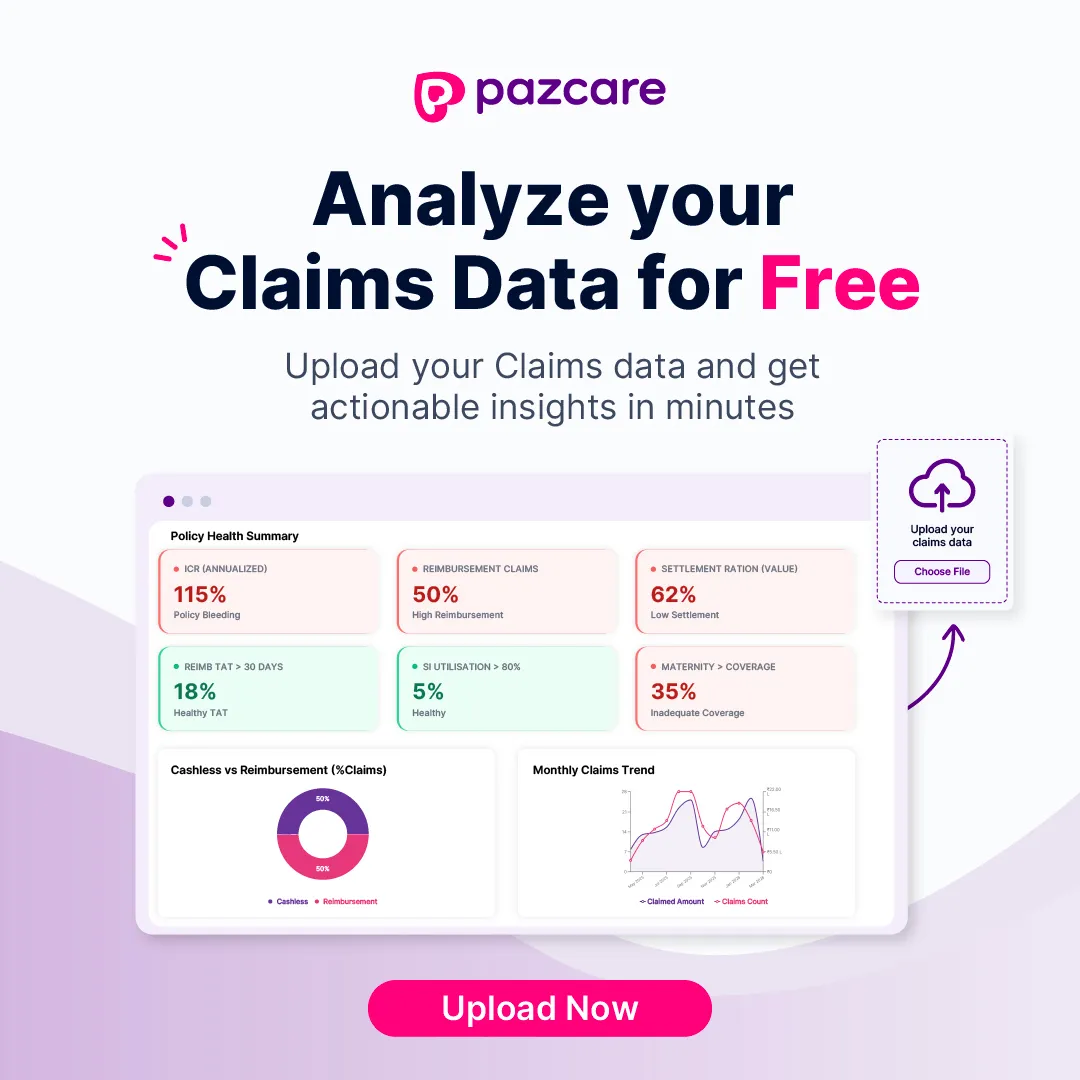
HR teams can track their incurred claim ratio (ICR), utilization trends, and renewal risk using PazClaimIQ by Pazcare before renewal discussions begin.
The impact
Data-driven negotiations often carry more weight with insurers and can help employers justify lower renewal increases.
3. Preventive healthcare programs
The most effective way to reduce insurance costs is to reduce avoidable claims.Many common health conditions such as diabetes, hypertension, obesity, and cardiovascular issues can be identified early through preventive care.
Pazcare supports employers through wellness and preventive health initiatives that encourage employees to focus on long-term health rather than only seeking treatment after illness occurs.
Programs may include:
- Annual health checkups
- Preventive screenings
- Wellness campaigns
- Mental health support
- Fitness challenges
- Nutrition awareness programs
These initiatives not only improve employee wellbeing but can also reduce healthcare utilization over time.
The impact
Healthier employees generally lead to:
- Fewer hospitalizations
- Lower claims frequency
- Better productivity
- More stable premium growth
4. Policy design optimization
A common misconception is that reducing costs always requires reducing benefits.
In reality, smarter policy design can often deliver significant savings while maintaining employee satisfaction.
Pazcare evaluates every aspect of the group health insurance policy to identify opportunities for optimization.
This may include reviewing:
- Sum insured levels
- Family floater structures
- Parent coverage options
- Room rent limits
- Deductibles
- Co-payment structures
- Voluntary top-up plans
The objective is not to cut benefits but to ensure every benefit provides meaningful value relative to its cost.
The impact
Companies achieve a better balance between employee wellbeing and financial sustainability.
How Pazcare helped a company reduce premium hike
Company profile
Industry: SaaS
Employee strength: 500+
Policy type: Group health insurance policy covering employees and dependents
Renewal stage: Annual policy renewal
The challenge
The company had experienced higher-than-normal claims during the policy year. As renewal approached, the insurer proposed a premium increase of 22%.
The HR and finance teams were concerned because:
- The increase would significantly impact budgets
- Employee benefits needed to remain unchanged
- Leadership wanted greater cost predictability
Accepting the renewal quote would have increased annual healthcare spending substantially.
Pazcare's approach
Before entering renewal discussions, Pazcare conducted a detailed review of the company's healthcare data.
The team analyzed:
- Claims ratio performance
- High-cost hospitalization trends
- Utilization patterns
- Dependent claims behavior
- Industry benchmarks
Several opportunities for optimization were identified.
Pazcare then:
- Prepared a detailed renewal strategy
- Presented claims performance data to insurers
- Negotiated with multiple insurance partners
- Recommended targeted policy optimizations
- Benchmarked market pricing
The outcome
| Metric |
Initial Situation |
Final Outcome |
| Proposed Premium Hike |
22% |
— |
| Negotiated Premium Hike |
— |
8% |
| Reduction Achieved |
— |
14 percentage points |
| Employee Benefits |
Maintained |
Maintained |
""
The company successfully preserved employee benefits while reducing the expected increase by more than half.The result was significant savings without compromising coverage quality.
Tips for companies to keep group health insurance costs stable
Although some premium increases are inevitable, employers can take proactive steps to reduce long-term cost pressure.
Review claims quarterly
Do not wait until renewal season. Quarterly reviews provide visibility into utilization trends and help identify potential concerns early.
Promote preventive healthcare
Investing in employee wellbeing can reduce future claims and improve workforce health.
Consider:
- Annual screenings
- Vaccination drives
- Mental health support
- Lifestyle wellness initiatives
Educate employees about benefits
Many unnecessary expenses occur because employees do not fully understand their coverage.
Regular communication can help employees:
- Use network hospitals
- Avoid unnecessary out-of-pocket expenses
- Access preventive care benefits
Analyze coverage annually
Benefits should evolve with workforce needs.
Conduct annual reviews to determine:
- Which benefits are heavily utilized
- Which benefits provide limited value
- Whether coverage remains aligned with employee expectations
Maintain accurate employee data
Incorrect dependent information can increase costs unnecessarily. Regular audits help ensure policy records remain accurate.
Partner with an experienced employee benefits advisor
Insurance renewals are increasingly data-driven.
Working with a specialist partner like Pazcare provides access to:
- Market intelligence
- Claims analytics
- Renewal benchmarking
- Negotiation expertise
These capabilities often result in better outcomes than managing renewals independently.
Keep healthcare costs predictable with Pazcare
Looking to reduce your next group health insurance premium increase?
Pazcare helps companies compare insurers, optimize policy design, analyze claims data, and negotiate better renewals so you can continue offering high-quality group insurance for employees without overspending.
Talk to our experts today and discover how smarter benefits management can help your organization save costs year after year.









.svg)
.svg)