The Government of India's NIMHANS National Mental Health Survey found that the treatment gap for mental disorders in India ranges between 70% and 92%, meaning most employees managing mental health challenges at work are doing so without any professional support. For most Indian workforces, it is the only structured access to mental health support that employees will ever have.
Choosing a mental health provider based on brand recognition or price without evaluating counselor credentials, confidentiality architecture, multilingual support, and actual adoption data is the most common and most consequential mistake HR teams make in this category. The right platform is the one your employees will trust and use consistently, not the one with the most impressive feature list.
Sustainable improvement in workforce mental health requires cultural change alongside platform investment. Manager training, normalized mental health leave, reduced structural causes of burnout, and visible leadership commitment to employee wellbeing are what determine whether a mental health program changes anything real. The platform is infrastructure. Culture is what makes it work.
The Government of India's NIMHANS National Mental Health Survey found that the treatment gap for mental disorders in India ranges between 70% and 92%, meaning most employees managing mental health challenges at work are doing so without any professional support. For most Indian workforces, it is the only structured access to mental health support that employees will ever have.
Choosing a mental health provider based on brand recognition or price without evaluating counselor credentials, confidentiality architecture, multilingual support, and actual adoption data is the most common and most consequential mistake HR teams make in this category. The right platform is the one your employees will trust and use consistently, not the one with the most impressive feature list.
Sustainable improvement in workforce mental health requires cultural change alongside platform investment. Manager training, normalized mental health leave, reduced structural causes of burnout, and visible leadership commitment to employee wellbeing are what determine whether a mental health program changes anything real. The platform is infrastructure. Culture is what makes it work.
Mental health is now a workplace infrastructure decision
India's corporate workforce is under more psychological pressure than at any point in recent history. According to Ken Research, India's corporate wellness market is valued at approximately ₹20,000 crore, driven by rising healthcare costs, growing awareness of employee well-being, hybrid work models, and the need to improve workforce productivity and satisfaction. This growth comes at a time when employees are facing mounting psychological pressures from heavy workloads, always-on work cultures, blurred work-life boundaries, financial stress, and caregiving responsibilities, challenges that are increasingly reflected in absenteeism, attrition, and healthcare claims.
The Government of India's Economic Survey 2024-25, released by the Ministry of Finance, explicitly stated that hostile work environments, long working hours, and high stress levels are hindering India's economic momentum, and called for urgent workplace-level interventions to protect employee mental wellbeing. This is not a soft signal. When the national economic survey calls out workplace mental health as a productivity and growth risk, the case for structured corporate mental health programs has moved from the HR conference room to the highest levels of policy.
Modern employers are responding by investing in structured mental health programs that go well beyond a helpline number buried in the onboarding packet. Counseling access, therapy coverage, burnout prevention, manager sensitization training, mindfulness programming, and crisis support are becoming standard components of a competitive employee benefits package, not premium additions to it.
This blog helps HR leaders at Indian startups and SMEs understand what mental health programs include, which providers are operating in India, and how to evaluate and select the right one for their specific workforce.
Key Terms: NIMHANS stands for the National Institute of Mental Health and Neuro Sciences.
Why companies need mental health programs today
The scale of the problem
According to the NIMHANS National Mental Health Survey conducted by the Government of India, 10.6% of Indian adults suffer from mental disorders, with the treatment gap for mental disorders ranging between 70% and 92% across different conditions. Applied to a corporate workforce, this means that in a company of 100 employees, at least 10 are likely managing a diagnosable mental health condition, and most of them are doing so without any professional support.
According to the WHO, mental health conditions are estimated to cost the global economy USD 1.03 trillion in lost productivity between 2012 and 2030. India's contribution to that loss is disproportionate given the scale of its workforce and the severity of its treatment gap.
The impact on the workplace
Absenteeism and presenteeism: Employees with untreated mental health issues take more unplanned sick leave and, when they do show up, operate at a fraction of their capacity. Presenteeism, the cost of employees being physically present but mentally disengaged, is consistently harder to measure and more expensive than absenteeism.
Attrition: The Government of India's Economic Survey 2024-25 directly linked poor workplace mental health to workforce disengagement and attrition. Employees who feel their organization does not support their mental wellbeing leave faster, and the cost of replacing them ranges from 50 to 200% of their annual salary.
Rising healthcare claims: Stress-related physical conditions, including hypertension, sleep disorders, cardiovascular disease, and immune dysfunction, are among the fastest-growing categories in corporate group health insurance claims in India. Mental health and physical health are not separate cost centers. They are the same cost center with a delayed billing cycle.
Workforce expectations: Gen Z and millennial employees, who now constitute the majority of India's corporate workforce, evaluate mental health support as a standard component of the EVP. Organizations that cannot demonstrate genuine investment in employee mental health are at a structural disadvantage in talent attraction and retention regardless of compensation competitiveness.
What are mental health programs?
Mental health programs are structured, employer-sponsored initiatives that help employees manage their emotional, psychological, and social wellbeing through a combination of professional support, skill-building, and preventive care.
They are distinct from a one-off wellness webinar or a meditation app subscription. A genuine mental health program creates a system of support that employees can access consistently across different needs, different intensities of difficulty, and different stages of their career.
What they typically include
Therapy and counseling sessions: Access to licensed psychologists, clinical psychologists, and counselors for individual sessions covering anxiety, depression, relationship difficulties, grief, career stress, and other emotional challenges.
Employee Assistance Programs (EAPs): Confidential, short-term counseling and referral services that employees can access for both personal and work-related challenges. EAPs are the most common structured mental health benefit in Indian corporate settings.
Crisis support: 24/7 access to mental health professionals for employees experiencing acute distress, panic, or crisis events. This is non-negotiable in any serious mental health program.
Stress management workshops: Group-format programs covering resilience building, cognitive reframing, time management, and burnout prevention delivered by mental health professionals to teams.
Burnout prevention programs: Structured assessments and interventions designed to identify and interrupt burnout progression before it reaches the crisis stage.
Manager sensitization training: Programs that equip people managers to recognize signs of mental health distress in their teams, have supportive conversations, and connect employees to available resources without overstepping clinical boundaries.
Mental health assessments: Validated screening tools that help employees understand their current mental health status and identify areas requiring professional attention.
Meditation and mindfulness sessions: Evidence-backed mindfulness programs that build stress tolerance and emotional regulation skills across the workforce.
Key features to look for in corporate mental health programs
HR teams evaluating mental health program providers should assess vendors across these dimensions before shortlisting:
Counselor credentials and quality: Are therapists and counselors licensed under the Rehabilitation Council of India or equivalent Indian regulatory frameworks? What is the average experience level of the counseling network? Credential verification is the single most important quality check and the one most frequently skipped in vendor evaluations.
Confidentiality architecture: Does the platform guarantee that individual employee usage data is never visible to HR or management? If employees cannot trust that their sessions are private, utilization collapses regardless of how good the platform is.
Multilingual support: India's corporate workforce spans dozens of languages. A mental health platform that operates only in English is structurally inaccessible to a large portion of the employees it is supposed to serve. Verify the number of languages supported and whether native-language counselors are available, not just translated content.
Access formats: Does the platform offer video, voice, and chat-based sessions? Different employees prefer different formats and different formats suit different levels of distress. A platform with only one access modality will underserve a significant portion of its user base.
Crisis support availability: Is crisis support available 24/7, and what is the escalation protocol when a counselor identifies a high-risk employee? This is the feature most vendors claim and fewest deliver robustly.
Manager training capability: Does the platform offer structured manager sensitization programs, not just a resource library? Manager behavior is the primary filter through which employees experience workplace mental health support or the absence of it.
HR analytics and reporting: Does the platform provide aggregate utilization data, program adoption trends, and wellbeing indicators that HR can act on without compromising individual employee privacy?
Integration with employee benefits: Can the mental health program connect to the company's group health insurance for therapy coverage, to the HRMS for seamless enrollment, and to the broader employee benefits stack?
Platform adoption and retention rates: What percentage of enrolled employees actively use the platform beyond the first 30 days? Vendors who cannot answer this question have an engagement problem they are not disclosing.
How to choose the right mental health program for employees
Choosing a mental health program provider is not a feature comparison exercise. It is a workforce strategy decision that should be driven by your employees' actual needs, not a vendor's pitch deck.
Step 1: Assess your workforce's primary mental health gaps: Use engagement survey data, exit interview themes, absenteeism patterns, and group health insurance claims categories to identify whether your primary challenge is stress and burnout, access to counseling, manager behavior, or stigma and awareness. Different gaps require different program architectures.
Step 2: Define non-negotiables before evaluating vendors: Confidentiality, multilingual support, crisis availability, and counselor credentials should be non-negotiable filters that eliminate vendors before formal evaluation begins, not factors you check after you have already shortlisted based on price and brand.
Step 3: Verify counselor credentials independently: Ask every vendor for their counselors' specific qualifications and regulatory registrations. Do not accept "licensed professionals" as a sufficient answer. In a market where credential standards vary significantly, independent verification is essential.
Step 4: Ask for adoption data, not feature lists: The most important number a mental health platform can give you is its 90-day active user retention rate among enrolled employees. A platform with a strong feature set but low sustained adoption is not solving your problem. It is giving you something to show leadership while your employees continue to struggle without support.
Step 5: Run a pilot before committing to full deployment: Deploy the shortlisted platform with a representative group for 60 to 90 days before organization-wide rollout. Measure utilization, employee satisfaction, and manager feedback. The pilot is the only reliable evidence of how the platform will perform in your specific organizational context.
Step 6: Ensure integration with your existing benefits infrastructure: A mental health platform that exists as a completely separate vendor relationship from your group health insurance, HRMS, and other employee benefits creates administrative duplication and reduces the continuity of care your employees experience.
Top mental health program providers for employees in India
The Indian corporate mental health market has grown significantly, with providers ranging from pure EAP platforms to comprehensive clinical mental health organizations. Here is an honest assessment of the leading providers and where each performs best.
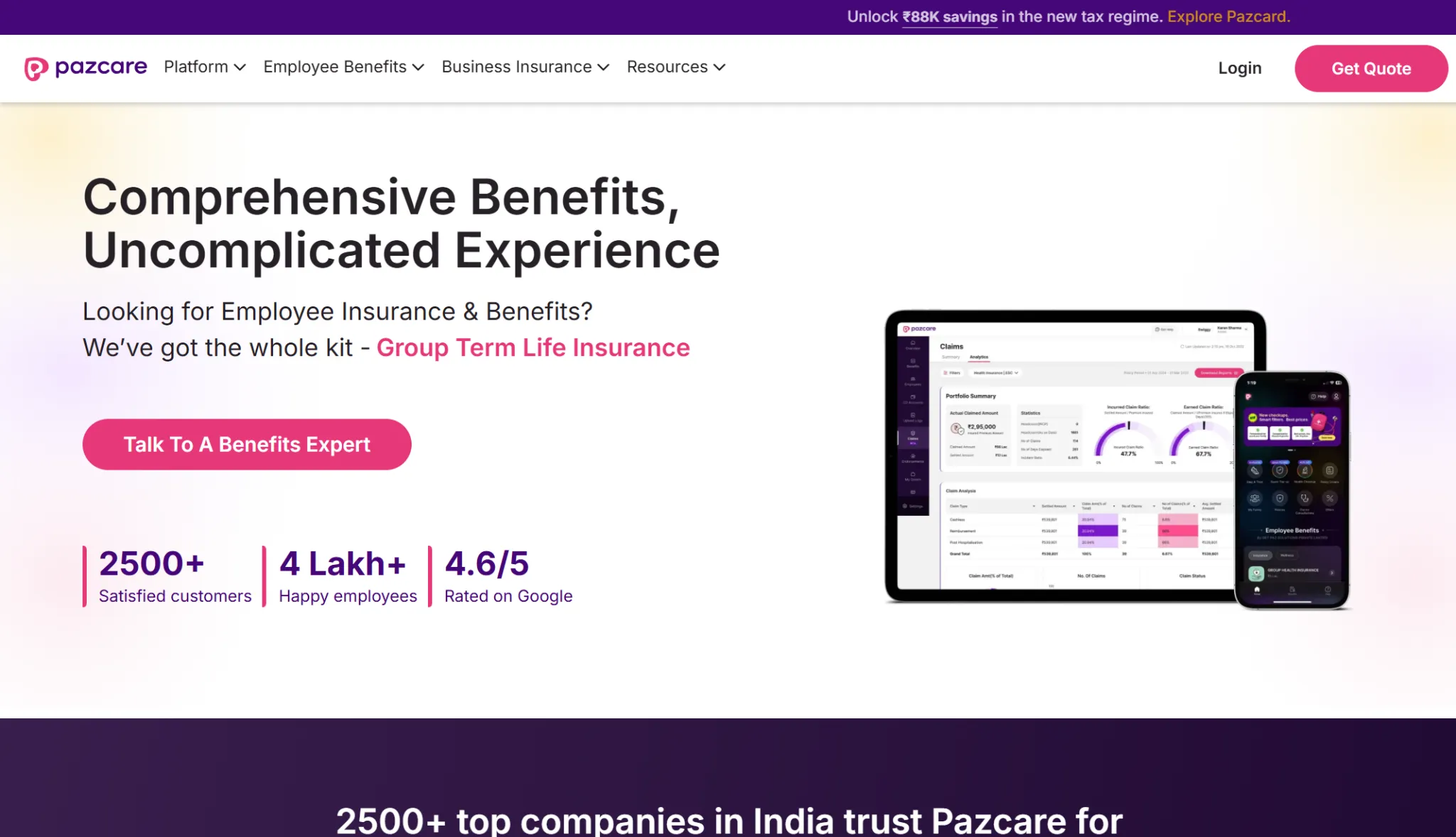
1. Pazcare
Pazcare approaches employee mental health not as a standalone platform but as an integrated component of comprehensive employee benefits administration. Mental health support through Pazcare is designed to work alongside group health insurance, OPD benefits, and other employee health management tools in a single connected benefits ecosystem.
This integration matters for a reason most standalone mental health platforms cannot address. The same employee who is accessing mental health counseling may also be generating physical health claims driven by stress-related conditions. Pazcare's connected benefits infrastructure makes it possible to identify this connection and design benefits interventions that address both dimensions simultaneously.
HR teams using Pazcare benefit from simplified benefits administration, mental health support that is built into the employee benefits program rather than managed as a separate vendor relationship, and a single platform view of employee health and benefits utilization.
Best for: Startups and SMEs that want mental health support integrated within their employee benefits program rather than managed as a separate vendor, and HR teams that want to reduce the complexity of managing multiple benefits platforms simultaneously.
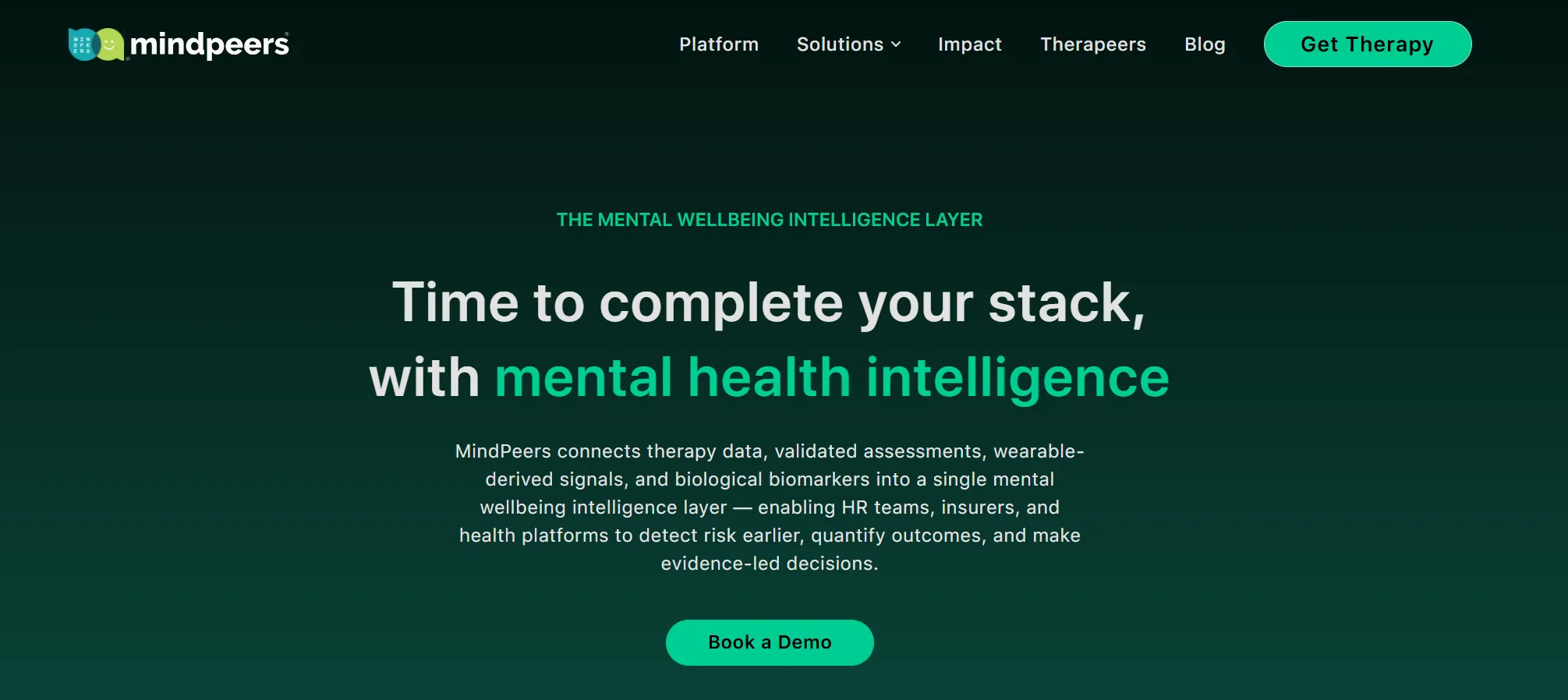
2. MindPeers
MindPeers is a digital-native corporate mental health platform built specifically for younger Indian workforces. Its product architecture emphasizes engagement through gamification, self-assessment tools, and community features alongside professional counseling access.
Key capabilities include personalized behavioral health interventions, mood tracking, therapist matching, mental health pre-screener assessments, and HR analytics dashboards that give people teams visibility into aggregate workforce wellbeing trends.
Best for: Tech startups and organizations with a predominantly Gen Z workforce that responds better to app-based, gamified wellness experiences than traditional EAP formats.
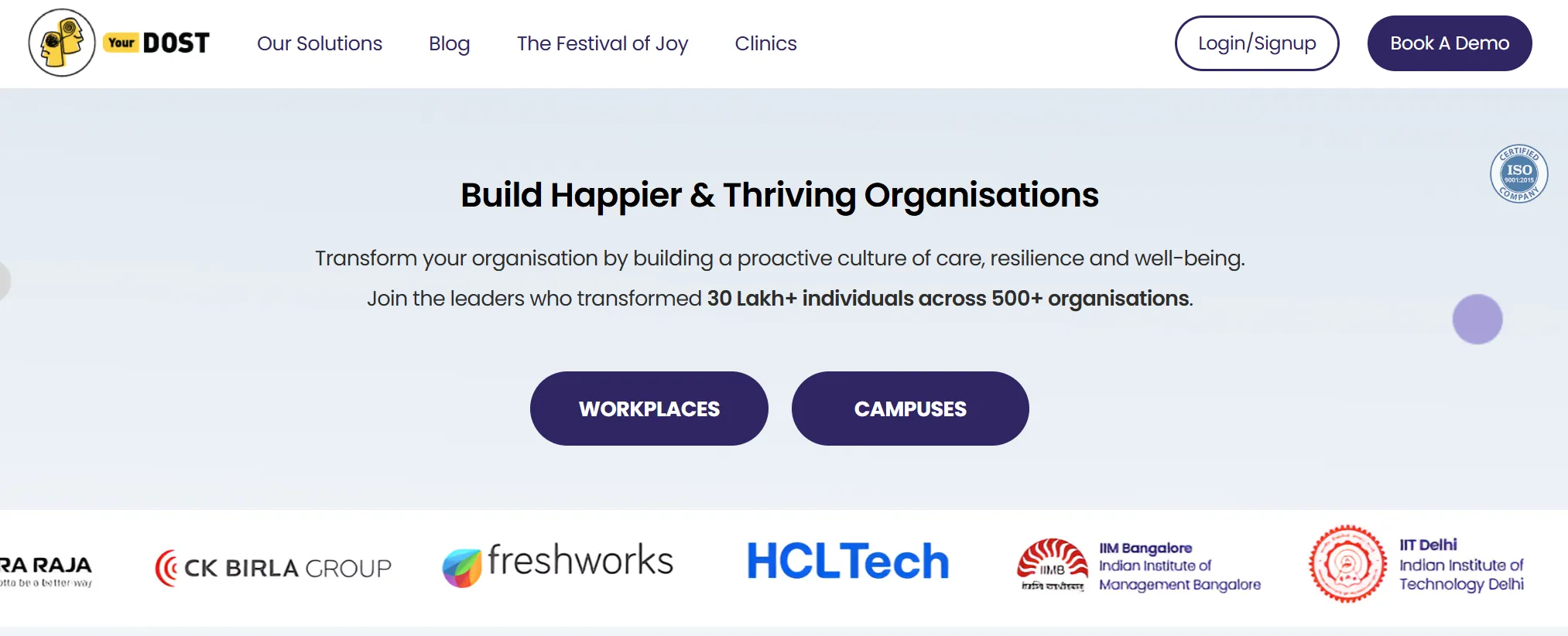
3. YourDOST
YourDOST is one of India's oldest and most established corporate mental health platforms, with a counselor network of over 1,000 professionals and a strong enterprise client base built over nearly a decade of operation.
Its model emphasizes emotional wellness, covering stress, anxiety, relationship difficulties, and career challenges through anonymous chat, audio, and video sessions. Corporate offerings include webinars, workshops, and mental health awareness programs alongside the core counseling platform.
Best for: Mid-size and large enterprises looking for a proven, high-credibility platform with a large counselor network, strong anonymity features, and a track record in Indian corporate settings.
4. Amaha
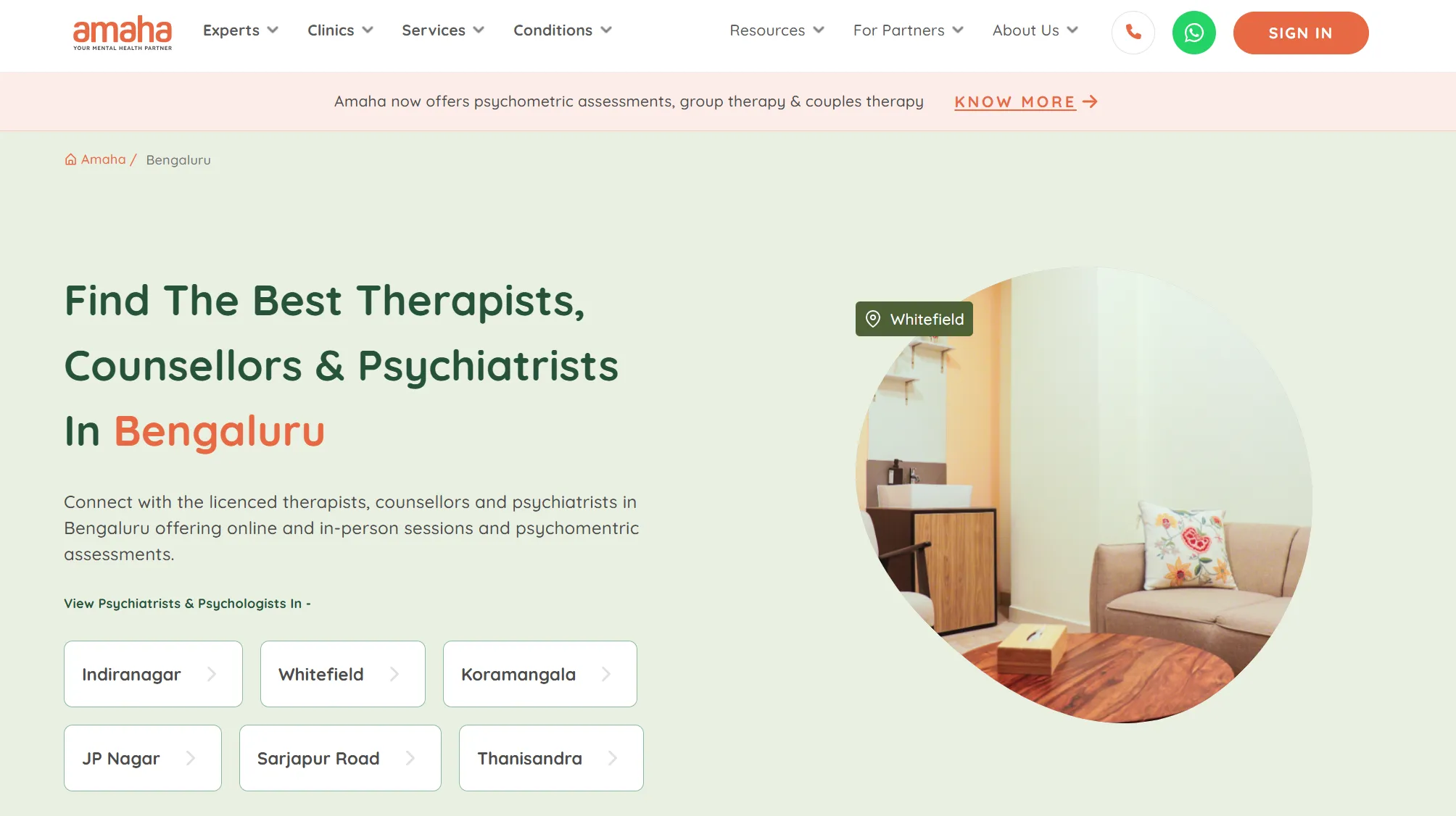
Amaha, formerly known as InnerHour, is one of India's most clinically comprehensive mental health organizations, combining digital therapy with in-person psychiatric services across Mumbai, Bengaluru, and Delhi.
Amaha has helped 4.5 million people across 300-plus Indian cities, with a team of 110-plus experts speaking 15-plus languages conducting over 50,000 therapy sessions, and partners with over 50 organizations for workplace emotional wellness programs. Lippincott Williams & Wilkins
Its corporate offerings span therapy, psychiatric consultations, self-care tools, and peer support, making it the most clinically integrated option in the Indian market for organizations that need to support employees with serious mental health conditions alongside those with everyday stress.
Best for: Organizations that need both clinical depth and digital accessibility, particularly those with employees managing diagnosed mental health conditions who require ongoing psychiatric care alongside therapy.
5. Ekincare
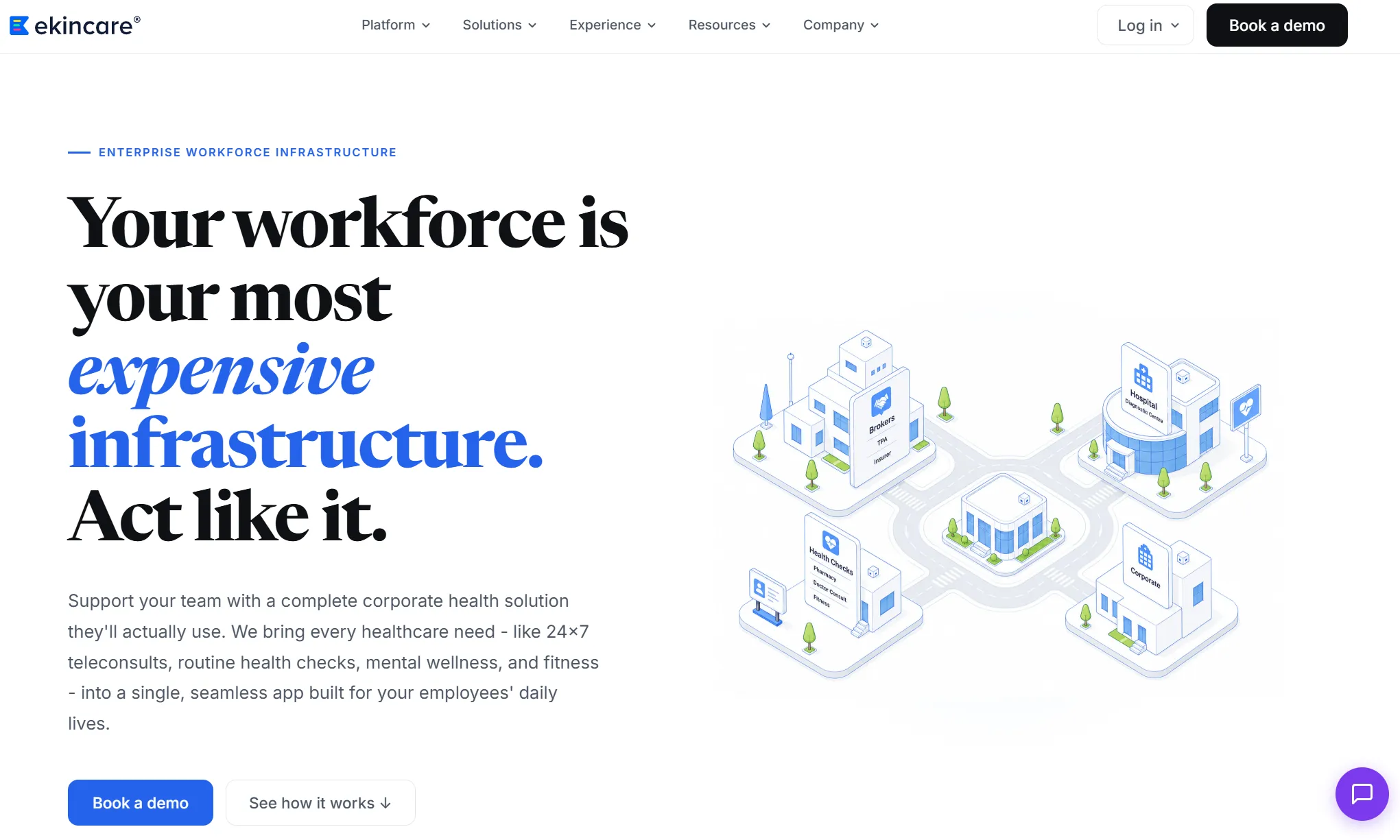
ekincare is a digital health platform with a strong integrated health and wellbeing proposition that includes mental health support alongside physical health management, preventive care, and health benefits administration.
Its mental health offering includes counseling access, stress assessments, mindfulness content, and manager training, integrated within a broader employee health management platform that connects to health insurance and health check data.
Best for: Organizations looking to integrate mental health support within a broader employee health management platform rather than deploying a standalone mental health tool.
6. Silver Oak Health
Silver Oak Health is a specialized workplace EAP and mental health provider with a strong emphasis on formalized, structured programs that address both employee emotional wellbeing and organizational productivity outcomes.
Its offerings span EAP services, counseling, organizational wellbeing assessments, manager training, and mental health workshops, with a focus on enterprise-grade program design and measurable outcomes.
Best for: Large enterprises and organizations in traditional sectors that prefer a structured, program-based approach to mental health with formal reporting and organizational productivity linkages.
7. MantraCare
MantraCare is a global employee wellness platform with a strong presence in India, offering mental health support alongside physical wellness, chronic disease management, and employee assistance programs.
Its mental health capabilities include therapy sessions, meditation programs, stress management tools, and manager training, delivered through a digital platform with multilingual support and a large therapist network.
Best for: Organizations with geographically distributed or global workforces that need a mental health platform with international reach and multilingual capability alongside Indian market depth.
8. BetterLYF
BetterLYF is a digital counseling and emotional wellness platform offering 24/7 secure video, voice, and chat-based therapy sessions with licensed counselors. Its corporate offering includes EAP services, wellness workshops, and mental health awareness programs.
The platform's strength is accessibility, with round-the-clock availability and a broad counselor network covering a wide range of mental health concerns from everyday stress to more complex emotional difficulties.
Best for: Organizations prioritizing round-the-clock counseling accessibility and a straightforward, no-frills EAP structure without the complexity of a full wellness platform.
9. Wysa
Wysa is an AI-powered mental health platform that uses conversational AI to provide employees with immediate, always-available emotional support, complemented by access to human therapists for more complex needs.
Its corporate offering positions AI as a first-response layer that helps employees build coping skills, manage everyday stress, and decide when to escalate to human counseling. This model is particularly effective for organizations where stigma around seeking help is high and employees need a lower-commitment entry point to mental health support.
Best for: Organizations with large workforces where per-employee therapy costs make traditional EAP models financially challenging, and where an AI-first approach to mental health literacy and self-management is strategically appropriate.
10. Trijog
Trijog is an Indian mental health organization offering corporate mental health programs through a combination of clinical services, training programs, and organizational wellness consulting. Its approach emphasizes building organizational mental health capability through manager training, workplace culture interventions, and employee sensitization alongside individual counseling access.
Best for: Organizations that want to build internal mental health capability through manager training and culture programs rather than relying entirely on an external platform for employee support.
How to improve mental health at work beyond employee assistance programs
A mental health program is infrastructure. Culture is what determines whether employees actually use it. Organizations that invest in a platform without addressing the cultural conditions that create mental health risk are treating symptoms while leaving the causes intact.
Normalize manager conversations about mental health: The single highest-impact action any organization can take is training managers to have genuine, non-stigmatizing conversations with team members about stress and wellbeing. According to the Government of India's PIB press release for World Mental Health Day 2024, a positive and supportive work environment is critical for fostering mental wellbeing, while adverse working conditions directly lower productivity and morale.
Establish and communicate mental health leave policies: Mental health days, formalized as a distinct leave category rather than borrowed from sick leave, signal organizational commitment in a way that no platform subscription can replicate. Employees who feel psychologically safe taking a mental health day without career consequence are the ones who return to work genuinely recovered.
Reduce the structural causes of burnout: No mental health program can compensate for a 70-hour work week, a culture that glorifies overwork, or a management style that tolerates chronic disrespect. The Economic Survey 2024-25 explicitly called for companies to prioritize work-life balance to sustain productivity. That is a structural change, not a platform feature.
Make mental health resources visible and accessible: Employees cannot use a mental health program they do not know exists or cannot easily access. Regular, normalized communication about available mental health resources, delivered through the channels employees actually use, is as important as the quality of the resources themselves.
Measure outcomes, not just enrollment: Track changes in absenteeism, engagement scores, and health insurance claims over time to evaluate whether the mental health program is producing genuine workforce outcomes. Programs that improve on these metrics deserve continued investment. Programs that do not should be redesigned or replaced.
Mental health support works best when it is integrated into a broader employee benefits program rather than managed as a standalone platform. Pazcare helps HR teams at Indian startups and SMEs connect mental health access, counseling support, and employee wellness within their group health insurance and benefits administration infrastructure.
Talk to a Pazcare benefits expert today to explore how mental health support can be built into your employee benefits program in a way that is accessible, confidential, and genuinely used by your team.
Samarth Okhade leads Wellness & In-App Business at Pazcare, driving category growth, partnerships, and operational scale. He has successfully built Pazcare’s wellness vertical into a high-growth business by combining strong GTM execution, vendor strategy, and customer-centric innovation.
Follow on:
Thanks for subscribing! If it’s your first time, check your inbox. Otherwise, you’re already on our list
Oops! Something went wrong while submitting the form.
Ready to give yourself and your team the best employee benefit experience?
What is the mental health program in the workplace?
Mental health programs in the workplace are structured, employer-sponsored initiatives that provide access to counseling, therapy, crisis support, stress management, and preventive mental health resources. They go beyond a one-time wellness webinar to create ongoing, accessible systems of support that employees can use consistently across different intensities of mental health need.
What is the difference between an EAP and a mental health program?
An Employee Assistance Program is a component of a mental health program. EAPs typically provide short-term, confidential counseling and referral services for employees dealing with personal or work-related challenges. A comprehensive mental health program includes EAP access alongside therapy coverage, crisis support, burnout prevention, manager training, mental health assessments, and wellness initiatives. An EAP is a starting point. A mental health program is a complete infrastructure.
How much do employee mental health programs cost in India?
Pricing varies significantly by program depth and workforce size. Basic EAP access typically ranges from ₹500 to ₹1,500 per employee per year. Comprehensive mental health platforms with therapy access, manager training, and analytics typically range from ₹2,000 to ₹6,000 per employee per year. Clinical-depth platforms with in-person psychiatric services and digital integration may be priced higher depending on utilization structure. HR teams should evaluate total cost of ownership including implementation, communication, and administration rather than per-employee fee alone.
How can employers improve mental health in the workplace?
The most impactful actions are cultural rather than platform-related. Train managers to recognize and respond to mental health distress without stigma. Formalize mental health leave as a distinct policy. Reduce the structural causes of burnout including excessive working hours and always-on communication expectations. Make mental health resources visible and regularly communicated. And measure outcomes over time through engagement survey scores, absenteeism data, and health insurance claims trends rather than just tracking platform enrollment numbers.
Are mental health programs covered under employee benefits?
Mental health support can be integrated within employee benefits in several ways. Group health insurance policies in India increasingly include OPD coverage that can be used for outpatient therapy sessions. Some policies include mental health treatment coverage as a standard or add-on benefit, a direction explicitly supported by IRDAI's regulatory evolution. EAP access is commonly bundled with employee benefits packages by platforms like Pazcare. HR teams should review their current group health insurance policy to understand what mental health coverage already exists before procuring a standalone program.









.svg)
.svg)